
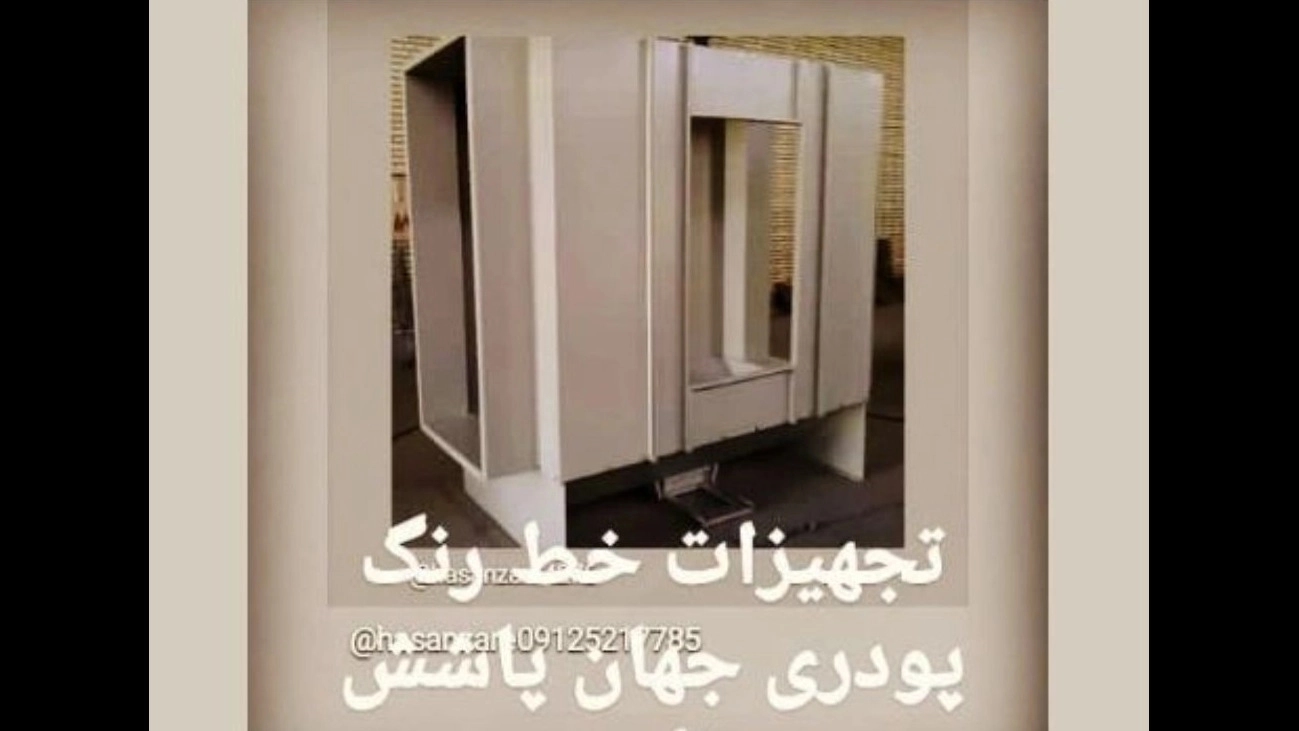
The industrial paint line is a complex and vital set of equipment that is responsible for applying protective and decorative coatings on production parts. The final quality of the product, the durability of the coating against corrosion and environmental factors, and the overall productivity of the production process, are highly dependent on the correct operation and integrity of the equipment of this line.
Using modern and efficient equipment in the paint line plays a central role in reducing operating costs (through reducing material and energy waste), increasing uniformity and repeatability of coating, and strictly complying with environmental requirements. In this article, we will comprehensively review the main components, used technologies and new trends in industrial paint line equipment.
Choosing the type of color line depends on the nature of the part, the volume of production, and the type of coating required.
These lines are used to apply solvent or water based paints. Their main advantage is high flexibility and the possibility of achieving different coating thicknesses. The need for strong ventilation systems and management of solvent vapors (VOC) is one of the main challenges of these types of lines.
In these systems, the color powder is electrostatically charged on the piece and then baked in the oven. This method has become very popular due to its high transfer efficiency, no use of solvent and uniform coating.
Automatic color line: suitable for production with very high circulation and parts with fixed geometry. Use of robots and fully automatic spraying.
Semi-automatic paint line: a combination of manual operations (such as preparation or spraying of difficult spots) and automation (such as transfer and curing).
Hand paint line: suitable for low volume production, custom parts or repairs.
Characteristics of liquid paint line and powder paint line
Medium transmission efficiency (depending on spraying technology) High (usually above 90%)
Environmental pollution of VOC production and vapors of recyclable waste powder production
Cooking time is usually shorter, requiring higher temperature and specific cooking time
Covering thickness can be precisely adjusted, the final thickness is usually slightly higher
A standard paint line consists of successive and interdependent parts, each of which plays a vital role in ensuring the final quality.
3-1. Surface preparation system (Pretreatment)
The quality of paint adhesion and the piece's resistance to corrosion directly depend on the success of this step. This system includes the following steps:
Degreasing: removal of oils, greases and surface contamination (usually with alkaline or solvent solutions).
Rinsing: removal of chemical residues.
Chemical conversion (Conversion Coating): applying a protective layer such as phosphating (iron or zinc phosphate) to create a reactive surface for paint and increase corrosion resistance.
Final Rinse: Often with deionized water (DI Water) to prevent residual solvents.
This operation can be done as immersion (Immersion) for parts with complex geometry, or spray (Spray) for large parts and high-speed processes.
3-2. Paint Booth
A cabin is a chamber where paint spraying is done. Its main purpose is to separate the spraying environment from the outside environment and control the air flow.
Liquid paint cabin: usually has a suction system from the bottom or back (Down-draft or Back-draft) to direct the polluted air to the filters and prevent the accumulation of vapors.
Powder paint cabin: designed to absorb and recover excess powder. It has cartridge or cyclone filters to separate the powder from the air flow.
Exact control of positive/negative pressure and the use of HEPA filters or multi-stage filters is essential.
These equipments have the task of atomizing and transferring color to the surface of the part.
Spray guns:
HVLP (High Volume Low Pressure): for liquid paint, with higher transfer efficiency than old methods.
Electrostatic: both in liquid and powder systems, applying high voltage to the nozzle causes the paint particles to be charged and their better absorption to the grounded piece (Faraday Cage Effect) and greatly increases the transfer efficiency.
Paint spraying robots: used for perfect repeatability and fast and quality coating in automatic lines.
Conveyors are responsible for moving parts from one station to the next.
Chain Conveyor: The most common type for paint lines with medium capacity.
Monorail: more flexibility in routing.
Power & Free: the ability to stop parts locally without stopping the entire line, suitable for complex processes such as preparation or cooking.
Accurate coordination of conveyor speed with spray time, cure, and drying rate is critical to avoid paint build-up or lack of coverage.
After spraying, the parts enter the oven to cure the coating. This process causes chemical reactions (polymerization) and creates the final physical and chemical properties of the paint.
Heat transfer furnaces:
Convection: using hot air to transfer heat.
Infrared (IR): using direct radiation to quickly heat the surface of the part.
Hybrid: combination of IR to start cooking and convection to complete it.
Temperature Control: It is important to use accurate sensors and PID systems to maintain a uniform temperature throughout the furnace chamber, especially in the inlet and outlet areas. Fluctuations in temperature directly affect the quality of cooking.
In powder lines, due to the use of the electrostatic method, a large part of the unsprayed powder can be collected, sieved and reused by cyclone or filter systems. This dramatically reduces material waste and operational costs.
Automation is the backbone of modern color lines.
PLC (Programmable Logic Controller): The brain that controls the sequential operation of the line, from the timing of the washing steps to the speed of the conveyor and the activation of the pistols.
HMI (Human-Machine Interface): Touch user interface through which operators can monitor and adjust key parameters (temperature, pressure, times).
Inline Quality Control: Using sensors to continuously measure dry film thickness (DFT) and ambient humidity. Automation allows spray settings to be adjusted on the fly to compensate for small fluctuations.
Paint line equipment must meet strict standards:
VOC control: In liquid lines, ventilation systems should be equipped with thermal oxidizers or carbon absorption systems to oxidize volatile organic compounds (VOCs) before they are released into the environment.
Air filtration and waste management: Cabins should have effective filtration systems to prevent airborne particles from entering the coating, as well as safe collection of paint and chemical waste.
Operator safety: use of personal protective equipment (PPE), automatic fire extinguishing systems, and ergonomic design of cabs to minimize operator contact with chemicals and paint.
Equipment selection should be based on a detailed analysis of production needs:
Type of product and production run: Is the product uniform or does it require quick changes (Batch Changeover)?
Part dimensions and geometric complexity: Large parts or with closed angles require specialized guns and precise robotic programming.
Expected quality and standards: For the automotive or aerospace industries, there is a need for more precise controls on surface quality and coating thickness (such as the use of two-component paints or ovens with very precise temperature control).
Energy consumption and maintenance cost: Choosing optimal furnaces and efficient power transmission systems (such as high-efficiency motors) can significantly reduce running costs.
common problem root cause technical solution
Orange Peel Improper paint viscosity, insufficient atomization, or high spray pressure. Accurate adjustment of flow rate, air pressure, and electrostatic voltage.
Sagging/Running, excessive thickness in one step or lower baking temperature than desired. Reducing the thickness of the applied layer, or increasing the furnace temperature.
Lack of uniform coverage (Dead Zones), poor planning of the robot or incorrect operation of the ventilation system in the cabin. Examining blind spots in robot planning and ensuring proper air flow.
Equipment failure and line stoppage irregular maintenance of filters, nozzles or sensors. Implementation of preventive maintenance (PM) program based on operating hours.
The coating industry is moving towards smartness and sustainability:
Artificial intelligence and machine learning: use sensor data to predict component failure times and automatically adjust spray parameters (such as temperature-induced viscosity changes) to maintain consistent quality.
Robots and intelligent conveyor: 6-axis robots with 3D scanning capability for faster and more accurate spraying planning.
Environmentally friendly coatings: full migration to water-based and powder-based paints, and development of lower-energy curing ovens (such as UV/EB fast curing ovens).
Digitalization: complete connection of equipment to MES (Manufacturing Execution System) systems for complete tracking of each part from the moment it enters the line until it leaves.
Industrial paint line equipment is not just a set of machinery, but the beating heart of the quality of the final product. The selection, installation and correct maintenance of this equipment is a decisive factor in achieving the durability of the coating, reducing waste and ensuring competitiveness in the market. Investing in automation and following new trends not only reduces operating costs, but also paves the way for producing products with global quality standards. Designing an integrated system that manages surface preparation, spraying, and curing in a coordinated manner is the key to success in the industrial coatings industry.